Ask a room of Norwood drivers about their spare tire and most answers are a shrug. It is under the trunk floor or beneath the bed, it came with the car, and it has not been looked at since. Then a flat happens on a Sunday evening, the donut goes on, and its limits and condition suddenly matter a great deal.
Temporary spares are built to be temporary in specific, printed-on-the-sidewall ways. Full-size spares avoid most of those limits but share the same enemy: years of being forgotten. This checklist works through the spare in order, with the pass and fail signs for each line, so yours is ready before you need it.

What a donut is built to do
A temporary spare, the donut, is smaller, narrower, and lighter than a regular tire so it fits in less space and costs less to carry. The trade is capability. Most donuts carry a maximum speed around 50 miles per hour and a limited total distance, commonly in the range of 50 to 70 miles, printed right on the sidewall or the wheel. Those numbers are the design, not a suggestion for cautious people.
Donuts also run at much higher pressure than regular tires, typically around 60 psi, because a small air volume has to carry the same corner of the car. A donut that has sat untouched for five years is usually well under that pressure, which is the most common way the forgotten fifth fails: it is technically present and practically flat. Handling on a donut is noticeably different too, with longer stopping distances and less grip on the corner it supports.
The twice-a-year spare check
- Locate the spare and read its type: pass if you know whether it is a donut or full-size; fail if you have never looked.
- Check pressure with a gauge: donut pass is near its sidewall figure, commonly about 60 psi; a soft spare is a fail until inflated.
- Read the date code: pass if the spare is within a sensible age; fail if it is a decade old, however good the tread looks.
- Inspect the sidewalls: pass with no cracks or bulges; fail on any cracking, which age causes even with zero miles.
- Confirm the jack and lug wrench are present and move freely; fail if the wrench does not fit the lug nuts on the car now.
- On underbody spares, run the winch down and back up; fail if it binds or the cable looks frayed or rusted.
- Check the spare well for standing water; fail if the wheel is sitting in water, and find the leak.
Driving on the spare
With a donut fitted, the plan is simple: slow down, skip the highway speeds you would normally run, avoid towing or heavy loads, and drive directly to getting the regular tire repaired or replaced. It is a bridge to a shop like M & R Retreading & Oil Co, not a fifth regular tire on a probation period. The distance limit exists because the donut's tread and structure are not built for sustained heat and wear.
A full-size spare in good condition plays by regular tire rules, which is one argument for checking it and rotating it where the vehicle allows. But age applies to it equally. Rubber hardens and cracks over the years, and a spare that has never touched the road can still be too old to trust. The date code on the sidewall, a four-digit week and year stamp, tells the truth regardless of how the tread looks.
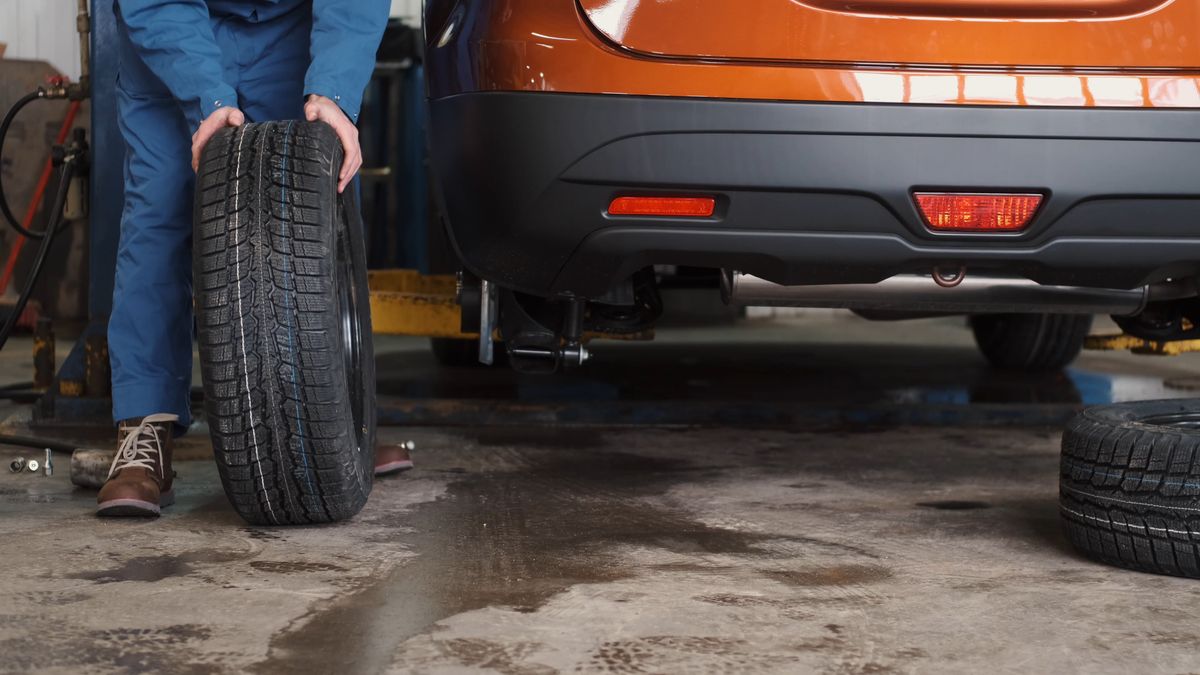
Storage, tools, and the rest of the kit
A spare is only half the system. The jack, the lug wrench, and any special key for locking lug nuts or the spare's own winch or latch have to be present and working. Trucks and SUVs that carry the spare underneath on a cable winch add a failure point: road grit and rust can seize the mechanism, and discovering that on a shoulder is miserable. Working the winch up and down once a year keeps it free.
While you are in there, look at the well itself. Water collects in spare tire wells from small trunk leaks, and a spare can sit in a puddle for months, rusting the wheel and aging the rubber. A dry well, a clean tire, and tools that move are the whole goal. It takes ten minutes twice a year, which is cheap insurance against the worst version of a flat.
Common questions
How far can I really drive on a donut?
Plan on the sidewall limits, typically about 50 miles per hour and 50 to 70 miles total. It is built to get you to a repair, not to finish your week.
How often should I check spare pressure?
Twice a year catches most slow losses, and before any long trip is a good third check. Spares lose air like any tire, just with nobody watching.
My car has no spare, just an inflator kit. Is that enough?
Inflator kits handle small tread punctures and nothing else. A sidewall cut or a bent rim ends their usefulness, so know the limit before the day you meet it.
Photos in this guide are representative stock images.
← All guides from M & R Retreading & Oil Co← Back to M & R Retreading & Oil Co